Keystone State’ labeled, Philadelphia based H. A Weymann and Son c.1922 rare guitar. Ladder braced, spruce top, very beautifully grained dark rich red mahogany back and sides, mahogany neck and headstock, original ebony fretboard. I read where someone thought that Weymann used Cuban mahogany on their guitars, that makes sense.
This Weymann guitar appeared for sale on ebay in May 2013. It has Brazilian rosewood back and sides and a spruce top. It is a beautiful large vintage instrument, and does not carry a serial number (I asked at the time), therefore if I am correct that would date it late 1890’s. It has the Weymann decal shield shape that was used prior to 1910. “Weymann Highest Grade”.
Dimensions:
Total Length 38 1/2″
Body Length 19 1/2″
Upper Bout 10 1/2″
Lower Bout 14 5/8″
Body Depth 4 1/8″
Scale 25″
Unusually for the era it has banjo tuners. It also has beautiful purfling and sound hole rosettes, and mother of pearl fret markers.
I would love to hear from you if you own this guitar.
H. A. Weymann and Son was founded by Henry Arnold Weymann (c.1829 – 1892) who was born in Hanover, Niedersachsen, Germany about 1829. According to his descendent, Greg Weymann he was christened Heirich, but Henry is the name he used in America.
Henry migrated to America in 1852, arriving in Philadelphia where he lived the rest of his life. He was naturalized in 1858. In 1864 he commenced a small business and it is from this date that Henry later attributes to the founding of H.A. Weymann and Son. In 1865 he is reported in the Philadelphia Inquirer as having an annual taxable income of $136.
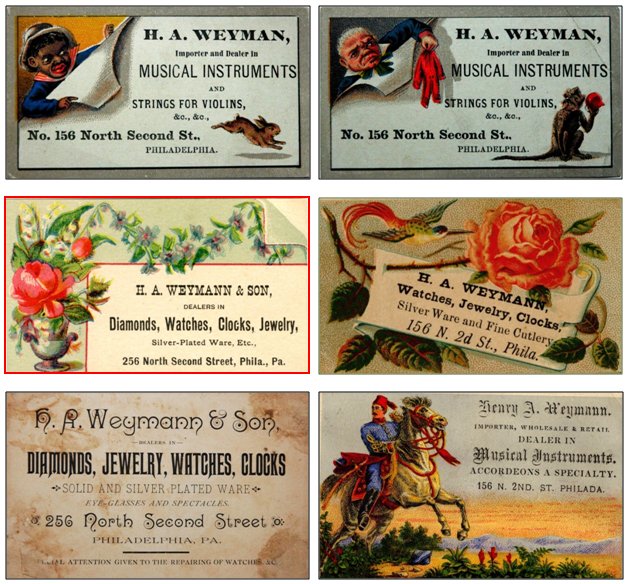
From early trade cards (late 1800’s and early 1900’s) it appears he started out selling diamonds, jewelry, watches and clocks. harmonicas, sheet music, and ‘small goods’, some of which were most likely imported from his birth country, Germany.
When his father died in 1892 the young 26 year old Harry (H. W. Weymann) energetically expanded the business.
In 1899 the S.S. Stewart Banjo factory in Philadelphia closed following the death of the company’s founder the previous year. There is conjecture Harry Weymann took advantage and purchased some of the materials and equipment from this factory and hired retrenched Stewart workers to greatly expand his manufacturing.
So when I had chemotherapy pretty much all my hair fell out, including my beard which I’d had for 30+ years. Now I’ve finished chemotherapy (Taxotere) and started another drug, Enzalutamide, my hair is growing like crazy! I’m thinking I look like Einstein, but of course one of my kids says “Einstein, yeah right Dad, more like one of the 3 Stooges!” (Do people still remember them?)
There is an ongoing debate amongst some academics, politicians and doctors as to whether routine screening for prostate cancer using the simple PSA blood test is necessary. Their argument is based on numerous clinical studies (some inconclusive or contradictory) that supposedly show that there is no significant statistical survival benefit for men getting regular prostate cancer screening with a PSA compared to those men who did not have a PSA screening.
I remember when I first requested a PSA test in a health checkup from my general practitioner (that ultimately diagnosed my cancer), that he tried to talk me out of it. “If you have prostate cancer do you really want to know?” he ask me. “Why wouldn’t I want to know?” I asked?
So after 19 treatments of the chemotherapy drug Taxotere over almost 2 years, it was ceasing to be effective, not to mention the terrible side effects.
So about 12 months ago I commenced Enzalutamide (marketed as Xtandi and formerly known as MDV3100) which has been developed by the pharmaceutical company Medivation for the treatment of metastatic castration-resistant prostate cancer. It has been available now since about 2013.
Very few people dispute that the childhood we experience determines what sort of adult we become. Or as William Wordsworth puts it “The child is father of the man” more widely interpreted as “The Child maketh the Man”.
I was bought up in a medium sized country town in NSW, Australia. It was a very beautiful town, it had a crystal clear river running through it, with willows on its banks and sandy shores. But the town also had its darker side.
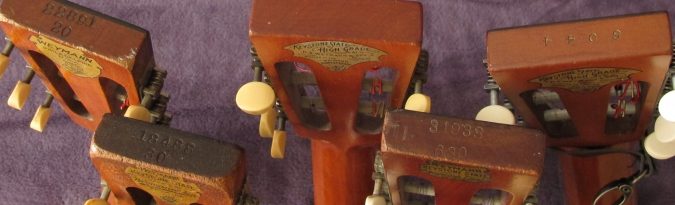
Weymann Guitars Serial Numbers on top of the Headstock
Introduction
(Updated 1 Feb 2019: With the addition of new information the serial number dating for Weymann instruments has now been revised. See the new dating table below:
(Update 10 May 2019: I came across this photo of a mandolin that was on a website by Tommy’s Guitars in Chicago:
Photo courtesy Tommy’s Guitars, Chicago
I contacted Tommy’s Guitars and they tried to find the original photo but the sale was some time ago and they could not find a better quality photo. But they do know that the documentation was dated 1899.
If I could find the now owner of this mandolin it could answer some questions about when H.A. Weymann and Son started serializing instruments, which at present those early years are a bit of a mystery. So if you bought this mandolin from Tommy’s Guitars, or now own this mandolin, or know who does, please contact me charles@koolaru.com . Many thanks, Charles.) end of update.
While there is evidence that H.A. Weymann & Son, Philadelphia, were making stringed instruments from 1894 or earlier for their retail outlet, it looks likely that they did not increase production for wholesale purposes until the late 1890’s. The catalyst for this was possibly the buying of production equipment and spare parts from the discontinued S.S. Stewart enterprise in 1898, also of Philadelphia.
Their very early banjos and guitars carried a gold decal, but no serial or style (model) number. Still later they carried a serial number but no style number. I believe around 1900 they finally added a style number as well.
(For more information on DECALCOMANIA as instrument decoration visit this post)
About as decorative as you can get with a guitar. Concert sized all birch construction with all of the Oscar Schmidt construction traits. First guitar I bought and quickly found that I wasn’t game to make it into a better playing guitar for fear of decreasing its value, so I resold it. Mother of toilet seat fret board and an original fancy reflective pick guard, edged in a gold sparkle material, makes this Stella a show pony.
Nickle plated tailpiece and a floral decal (decalcomania is where the abbreviated word ‘decal’ comes from) that simulated inlaid timbers. Stamped on the headstock with the gold underlined Stella logo.